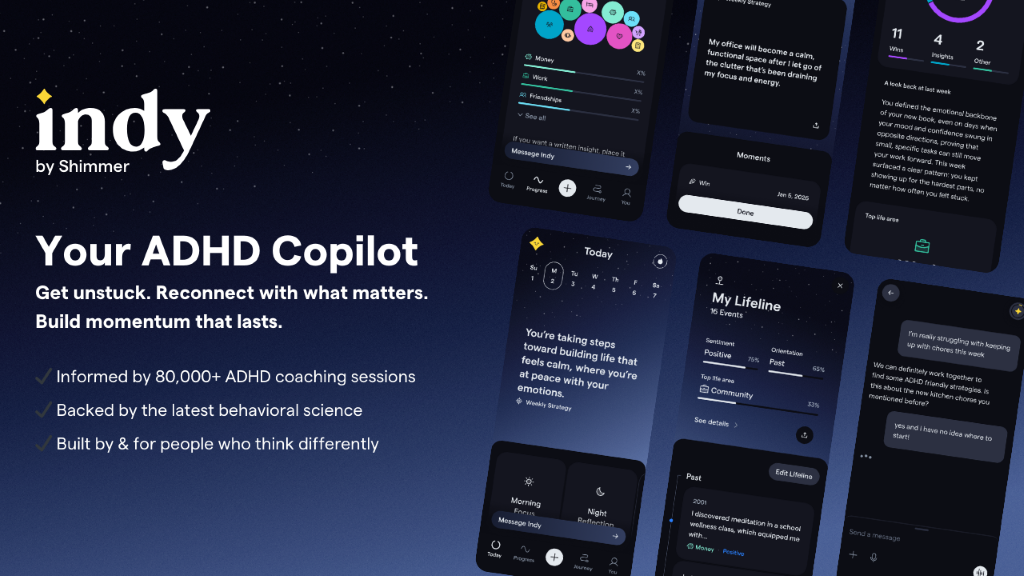
💡 TL;DR: We’ve launched Indy by Shimmer, an AI-powered ADHD app designed to help adults stay oriented to what matters over time. Our contemporary approach to ADHD support embraces an ecosystem of coaches, community, and tech-enabled programs that allow long-term care to scale.
The Evolution of Shimmer
From the beginning, Shimmer has operated at the intersection of expert human support and technological enablement. Our Coaching program focused on removing structural barriers to high-quality ADHD coaching by making certified coaches more accessible.
Our platform allows ADHDers to:
- find coaches who matched their needs at an affordable cost (4-7x times lower than average),
- easily onboard the same day,
- and get started in less than a week.
As technology evolved, we relaunched the app with several AI features (at no additional cost!) in our coaching plans, which allowed for even better support:
- session summaries to remember discussions across time,
- automatic parsing of action items for quick reference and implementation on weekly goals,
- smart search through notes to find common patterns, past strategies, and learnings.
We then expanded into community and asynchronous learning environments that could encourage meaningful reflection, identity development, and ADHD psychoeducation beyond live coaching sessions. Our virtual environment allowed ADHDers access to:
- world-class ADHD workshops, experts, & lived experience advocates
- asynchronous learning that was accessible 24/7
- other ADHDers developing similar skills and from various walks of life
- live, coach-hosted co-working sessions alongside fellow ADHDers
Our newest launch of Indy emerges from this same lineage, using technology to allow ADHD care to exist, in an affordable way, where it would otherwise not.
Addressing the ADHD Tax Through Technology
Our work at Shimmer requires us to stay up-to-date on what research suggests the ADHD community needs and then explore how we can apply technology can make that available in everyday life.
"I believe that digital, data and technological domains have the potential to improve the quality of life for those with ADHD dramatically. ADHDers pay too much “ADHD tax” and benefit too little from the strengths often present in those who are neurodivergent. AI-enabled tools can change that."
—Principal Scientific Officer Applied Psychology & Technology, Shimmer
In the past three years, advances in AI have meaningfully expanded what’s possible in support systems, opening up new opportunities for accessibility.
- Adults with ADHD disproportionately experience what is referred to as the “ADHD tax” due to executive functioning challenges: costs associated with missed opportunities, disrupted careers, financial penalties, relationship strain, and reduced well-being. At the same time, the strengths frequently associated with ADHD (e.g., creativity, adaptability, divergent thinking, energy, and problem-solving) are under-leveraged.
- AI-enabled tools create a different possible future. They can help reduce administrative work, support cognitive flexibility and agile thinking, and recognize and track patterns across time that individuals may not recognize. That offloading of effort allows ADHDers to spend more of their time and energy on their strengths rather than on compensating for gaps in support.
- AI can be an equalizer precisely because it isn’t a human service. High-quality ADHD support has historically been constrained by cost, geography, and availability. Many adults live in rural or underserved areas, work nontraditional or rotating schedules, or cannot afford weekly, ongoing care. In these contexts, support isn’t reachable.
- AI-enabled systems allow support to exist outside standard business hours, across time zones, and independent of location. By lowering the cost of ongoing care and removing the need to coordinate around appointments, these systems make continuity of support possible for people whose lives do not fit traditional care models. This shifts access from being a privilege of circumstance to something more widely available.
While AI can act as a powerful equalizer, its greatest value is how it expands what becomes possible across the broader landscape of care. Rather than replacing human or community-based care, AI helps create the conditions where different types of support can be accessed and extends the capabilities of different types of providers.
Embracing a Systems Approach to ADHD Care
We’re excited by the possibilities technology opens up for expanding ADHD support. At the same time, it’s important to be clear about what we believe technology is and is not meant to do. We do not view tech-enabled tools as replacements for human care. Instead, we see them as one part of a broader ecosystem that supports people across different needs.
Different types of ADHD support are often framed comparatively: therapy vs. coaching, pills vs. skills, human vs. technology. While these distinctions can be useful to make sure someone is getting care that is necessary, they create a limited perspective that there should be a “best” option for everyone, but there is no one-size-fits-all option.
- Clinical care is important for diagnosis, medication management, and treatment of co-occurring conditions.
- Coaching supports self-regulation, perspective, and meaning-making
- Community offers connection, normalization, and shared understanding
Indy is designed to contribute within a non-clinical part of the ecosystem where technology is uniquely capable: reducing cognitive load, organizing thoughts/patterns/reflections, and tracking data across time to reflect on. This creates rich material for users to learn about themselves. Indy is not a substitute for coaching, therapy, or community-based care since human-centered support remains irreplaceable.
Looking Ahead
The future of ADHD support will not be defined by a single intervention, modality, or technology. It will be shaped by how well we design systems that work together and allow ADHDers to personalize their support and move between layers of care fluidly as needed. AI introduces a new capability into this ecosystem and reflects what we’ve learned from years of working alongside ADHDers, coaches, researchers, and community members.
We’d love for you to try Indy and share your thoughts with us.